



The Revolutionary Guards: An Introduction
The Islamic Revolutionary Guard Corps (IRGC) is the Islamic Republic of Iran’s most important institution. The military-security institution commands huge influence in every aspect of Iranian public life, from culture and the environment to the economy, politics and judicial process. Whatever the field or area, the IRGC is not required to report to anybody and is answerable to no one.
The IRGC was created early after the 1979 Islamic Revolution by the order of the founder of the Islamic Republic, Ayatollah Ruhollah Khomeini. Its declared mission was to safeguard the revolution and its accomplishments. As the years have gone by, it has expanded its sphere of activities. The entities under its control have multiplied to such a degree that it now operates effectively as a parallel government. It interferes in all current affairs of the country and it aims to have control over every aspect of the way Iran is run.
In a series of reports, IranWire presents a detailed portrait of this powerful and mysterious institution and, for the first time, identifies and explains all bodies, institutions and other entities operating under the umbrella of the Revolutionary Guards, at the same time outlining its activities through an infographic and an interactive diagram.
The infographic is a visual representation of the Guards’ organizational structure and presents all institutions under the control of IRGC in one map. It resembles a family tree, a portrait of the IRGC with all its children, grandchildren and great-grandchildren — a dramatic picture of power in Iran today.
In the interactive diagram, the viewer is able to use the mouse to see how various entities under the control of the Guards emerged, and how they are connected — exactly like a family tree.
IranWire has aimed for this series and the overall project to be informative and a solid research tool. But it is not perfect, and there will always be room for updates, enhancements and further information. We welcome your views, ideas and knowledge, so please do get in touch via email, Twitter or Facebook.
***
The IRGC Ground Forces- (Nirooy-e Zamini-e Sepah)
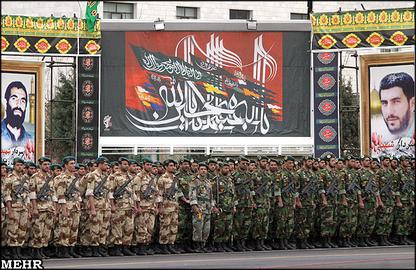
The IRGC’s Ground Forces, known as NEZSA, was informally established in February 1983 with the Ground Units of the IRGC (Ghovay-e Zamini-e Sepah). At the time, the IRGC organized its ground troops in the war with Iraq through Khatam-al-Anbia Headquarters and Najaf-e Ashraf Unit
The 7th Corps of Hadid and the 3rd Corps of Saheb-al-Zaman were subunits of Khatam-al-Anbia Headquarters, while the 11th Corps of Qadr and the 5th Corps of Nasr were subunits of Najaf-e Ashraf Unit. In 1983, IRGC commanders merged these units to form the Ground Units of the IRGC.
The organization structure was such that the Ground Units of the IRGC consisted of multiple corps, each having its own divisions. During military operations, these corps acted as the Frontline Headquarters of the Ground Forces (Gharargah-e Moghadam-e Nirooy-e Zamini).
On September 17, 1985, the then Supreme Leader, Ayatollah Ruhollah Khomeini ordered a new organizational structure for the IRGC. He directed Mohsen Rezaei, the IRGC chief commander, to establish the IRGC’s Ground, Navy, and Air Forces.
Until 1990, the IRGC Ground Forces managed the Basij militia. However, in that year, Ayatollah Ali Khamenei, who succeeded Khomeini in 1989, directed that Basij be separated from the IRGC Ground Forces, leading to the establishment of the Resistance Force of Basij as an independent organization.
In 2007, the IRGC Ground Forces underwent another restructuring through the IRGC Ground Forces Transformation Program (Tarh-e Tahavol-e Nirooy-e Zamini-e Sepah). The local Basij resistance bases, along with the IRGC Ground Divisions in each province, were integrated into the IRGC Provincial Corps in 2008.
Today, the IRGC Ground Forces coordinate their activities through 32 corps across Iran’s 31 provinces, with Tehran Province having two corps. Additionally, the Ground Forces have 11 military headquarters across Iran, which act as regional military units with independent structures. They manage and command the corps in different provinces and are supported by the IRGC’s Military Support Unit (Yegan-e Poshtibani-e Razm) and Service Support Unit (Yegan-e Poshtibani-e Khadamat).
The IRGC Ground Forces have 17 ranks and 10 divisions, covering a range of military specialties, including infantry, artillery, armored, mechanized, airborne, and special forces. The chief commander of the IRGC appoints one of the IRGC corps in different regions as the deputy commander of the headquarters.
The IRGC Ground Forces Commander
The commander of the IRGC Ground Forces is appointed by the Supreme Leader of Iran, who is the commander in-chief of the Armed forces. He also seeks recommendation of the IRGC’s chief commander.Since 1985, the commanders of the force have been:
- Yahya Rahim Safavi (September 1985 – April 1986)
- Ali Shamkhani (April 1986 – October 1989)
- Mostafa Izadi (October 1989 – July 1992)
- Mohammad Ali Jafari (July 1992 – August 2005)
- Ahmad Kazemi (August 2005 – January 2006)
- Mohammad-Reza Zahedi (January 2006 – July 2008)
- Mohammad Jafar Asadi (July 2008 – April 2009)
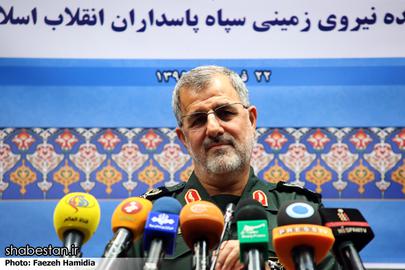
- Mohammad Pakpour (April 2009 – Present)
The Supreme Leader’s Representative in the IRGC Ground Forces
The Supreme Leader’s IRGC representative appoints his representative in the Ground Forces. The representative holds authority over appointments and dismissals in the Public Relations Division and oversees promotions within the force.Hojatolislam Mohammad Hadi Rezaei is the current representative of the Supreme Leader in the IRGC Ground Forces. His main responsibilities include providing ideological and cultural guidance to members of the force. He also organizes the annual deployment of approximately 3,500 clergymen to operational regions, particularly in the northwest and southwest of Iran, to boost soldiers' religious morale. Additionally, Rezaei strengthens coordination among the Supreme Leader’s representatives stationed in various IRGC Ground Forces posts and camps to ensure religious and ideological support for commanders.
The Divisions (Moavenatha)
The IRGC Ground Forces is under the command of its headquarters, led by the Ground Forces Commander. The IRGC Ground Forces has the following divisions: intelligence, training, operations, coordinator, human resources, public relations, and publications, poverty alleviation, and medical.
The IRGC Ground Forces Headquarters
In addition to its main headquarters in Tehran, the IRGC Ground Forces maintain ten regional headquarters:
Hamze Seyyed-al-Shohada Headquarters: Located in northwest Iran, this headquarters oversees the western borders with Iraq and Turkey, as well as the provinces of West Azerbaijan, Kurdistan, and Kermanshah. It is considered one of the IRGC’s most significant headquarters due to its involvement in key historical events, including the suppression of protests in Kurdistan in 1982 and ongoing conflicts with Kurdish opposition militias. The area under its control has seen some of the most intense battles.
Karbala Headquarters: Situated in the southwest, this headquarter controls the provinces of Khuzestan, Lorestan, and Kohgiluyeh and Boyer-Ahmad.The IRGC Ground Forces has 31 territorial commands in all 31 provinces of the country. Hazrat Abulfazl Headquarters in the city of Ahvaz is one of the most significant and is under the command of Karbala Headquarters. It focuses on security operations as well as monitoring and suppressing ethnic minority activities in the region.
Samen-al-Aeme Headquarters: Located in the northeast, controls the provinces of Northern Khorasan, Southern Khorasan, and Razavi Khorasan. It was established in 2017 following Khamenei’s order. According to its late commander, General Ghodrat al-Allah Mansouri (killed in an accident), the headquarters was formed to secure Iran’s eastern border with Afghanistan. The need for this was due to the instability of Afghanistan's central government and the rise of the Islamic State (Daesh) in the region. The headquarters also played a role in developing infrastructure in impoverished areas within these provinces.
Najaf-al-Ashraf Headquarters: This central region headquarters controls the provinces of Ilam, Hamedan, and Kermanshah. It was responsible for intelligence operations covering the three provinces during the Iran-Iraq War and according to its commander, General Mohammad Nazar Azimi, had 265 martyrs. Since 2017, along with other headquarters it has organized several memorials or “Yadvareh” for its martyrs. As part of its mission, it has organized committees for gathering documents related to the war in the three provinces. In addition, the headquarters has cooperated with the IRGC-affiliated Center for Holy Defense Publication and Documentation, Kermanshah branch, to publish 14 digital and 22 print volumes on the Iran-Iraq War.
In 2016, the Tabnak news agency reported that this headquarters eradicated a terrorist group, killing its commander and remaining 11 members. In 2018, three members of the base were reportedly killed during clashes with a jihadist group affiliated with Daesh (ISIL) bordering Kermanshah. In the aftermath of 2017 earthquake in Kermanshah, the IRGC-affiliated Tasnim website reported that the headquarters provided relief to earthquake victims through two specialized units: one for engineering and another for technology, healthcare, and drones.
Quds Headquarters: Situated in the southeast, oversees security in the provinces of Sistan and Baluchestan, and Kerman. It gained more authority in 2014 when it was tasked with securing Iran’s southeast borders. It is responsible for suppressing armed opposition and terrorist groups in Sistan and Baluchestan Province. The Quds Headquarters works alongside the southeast headquarters of the Iranian Army Ground Forces to secure the borders with Afghanistan and Pakistan. Beyond its military role, it carries out various projects, such as constructing housing units, hospitals, clinics, and roads, to increase the IRGC's social influence in the region. It runs a very specific scheme called the Security Scheme of Shahid Shooshtari (Tarh-e Amniati-e Shahid Shooshtari), which recruits and trains tribes and residents in the province into militia groups to support IRGC. Noor Ali Shooshtari, the commander of the Quds Headquarters, was killed in a suicide attack by Jundallah (People’s Resistance Movement of Iran) in 2009, an attack that also claimed the lives of at least 55 others and injured 157 people. The Airborne Division and Saberin Unit of the IRGC Ground Forces are also on standby in the region, ready to provide support with fighter jets and helicopters. The current commander of the Quds Headquarters is General Seyed Hasan Mortazavi who was appointed to this position in January 2023. Earlier, he was the commander of Samen-al-Aeme Headquarters and the Provincial IRGC Corps in the provinces of North Khorasan and Sistan and Baluchistan.
Al-Qadir Headquarters: Located in the north, this headquarters controls the provinces of Mazandaran, Golestan, and Gilan. Its origins date back to the 1985 Iran-Iraq War, when the provincial forces from these areas provided intelligence under the 25th Karbala Division. Together, these forces formed the Qadir Headquarters under the IRGC Ground Forces’ command. To strengthen the IRGC’s zeal, social influence and spirit of martyrdom, the headquarters organizes several memorials or “Yadvareh” for martyrs. It also supervises the activities of the IRGC in the three provinces. In more recent decades, forces under the command of this headquarters have clashed with the so-called counter-revolutionary forces bordering the northern provinces. For example, in 2011, the headquarters reported that it had eradicated two members of the Kurdish opposition party’s armed group, PJak (Kurdistan Free Life Party).
Medina Monavareh Headquarters: This southern base controls the provinces of Fars, Bushehr, and Hormozgan. It is the closest IRGC Ground Forces’ headquarters to the strategic Strait of Hormuz between the Persian Gulf and the Gulf of Oman. The base has hosted numerous IRGC military exercises, including the Prophet Muhammad Exercise Maneuver 9 in 2015, covering over 3,000 square kilometers from the Mobarak Mountain in the Jask Region through Bandar Lengeh and the Islands of Qeshm, Lark, Hengam and Hormoz. According to General Hamid Sarkhaili, commander of the headquarters at the time, “the maneuver was launched by the IRGC Ground Forces in cooperation with the Medina Monavareh Headquarters which provided 50,000 infantry commandos and armored forces.” He also said that the headquarters is equipped with “hundreds of launchers, anti-tanks, armors and missiles” and that it is ready to target potential enemies. The headquarters has also been involved in poverty alleviation and job creation projects worth 6.5 billion (Iranian rials) in the city of Sirk, constructing seminaries, mosques and public amenities.
Since 2010, Brigadier General Mohammad Marani has been the commander of this strategic headquarters. Earlier, he was the commander of Quds headquarters. The most important units under this headquarters are:
- Ansar-ol-Hojah Commando Brigade, based in Fasa in Fars province
- Imam Sajjad Commando Brigade in Kazerun in Fars province
- Imam Sajjad Brigade 34 in the port city of Bandar Abbas in Hormozgan province
- Imam Sadegh Brigade 39 in the port city of Bushehr in Bushehr province
- Fajr Division 19 in Shiraz in Fars province
- Al Mahdi Special Forces Brigade in Jahrom in Fars province
This headquarters regularly holds maneuvers in the Strait of Hormuz region. According to General Marani, in one of the most recent such maneuvers to protect the Strait of Hormuz, 50,000 commandos, infantrymen and armor crewmen participated.
Ashura Headquarters, commanded by Brigadier General Jalil Babazadeh, operates in the northwestern Iran. This headquarters covers the provinces of East Azerbaijan, Zanjan, and Ardabil. It includes a cyberspace headquarters in East Azerbaijan which its director, Mohammad Reza Seifi, claimed ranked as one of the top headquarters in the cyberspace sphere in 2018. It gained prominence for its activities in producing games, animation and software. Ashura Headquarters launched a military exercise across East Azerbaijan with the participation of the paramilitary Basij groups. According to the commander of the Ashura Base, these units were dispatched to provide medical, health and infrastructure services to poor and impoverished areas of the region.
Saheb-al-Zaman Headquarter: Positioned in the center of the country, this headquarter controls the provinces of Markazi, Qom, Semnan, and Qazvin. During the Iran-Iraq War, its forces were charged with intelligence operations at the front. Like other provincial headquarters, to strengthen social control in the provinces and strengthen its loyal supporters, the headquarters organizes memorials to commemorate the troops from the intelligence units of the three provinces who died in the War. In addition, it also runs camps to facilitate pilgrimages for the families of martyrs, particularly to the holy city of Qom.
Hazrat Seyyed-al-Shohada Headquarters: Covering the provinces of Isfahan and Yazd, this headquarter was engaged in intelligence operations during the Iran-Iraq War. According to its commander, General Javad Esteki, it suffered highest number of martyrs among the IRGC units. Esteki said that among 450 martyrs of the intelligence operation of Seyyed-al-Shohada Headquarters, 307 were from Esfahan, 90 from the 18 al-Qadir Brigade in Yazd, and 53 martyrs were from the Qamar Bani-Hashem Brigade in the province of Chaharmahal Bakhtiari. The headquarters includes various important military units, such as the 14th Imam Hussein Operational Division, the 8th Najaf Ashraf Division, the 44th Qamar Bani-Hashem Brigade, the 15th Khordad Missile Group, and the 40th Engineering Saheb ol-Zaman Brigade. It also controls military support centers like Amir-al-Momenin University and Shahid Sadughi Hospital along with thirty Basij battalions.
The Saberin Special Unit
The Saberin Special Unit of the IRGC Ground Forces was established in 2000. Members of this unit, called “takavar” (commando), undergo rigorous training including climbing, parachuting, and bodybuilding. The unit categorizes its commandos into three levels: Rapid Response (Vakonesh-e Sarie), Special Force (Nirooy-e Vijeh), and Special Operations Force (Nirooy-e Makhsoos).
The unit regularly participates in maneuvers and tests its new technological capabilities and new methods of commando warfare. For example, in December 2021, during a joint maneuver of IRGC’s Navy, Ground Forces and Aerospace Force called “Great Prophet 17”, it was reported that the Saberin Special Unit had not only successfully defended Iran’s coast but had also succeeded in establishing a bridgehead on the “enemy’s” coast.
Since its creation, the unit has been involved in some military operations along Iran’s western borders with Iraq and Turkey against the armed Kurdistan Workers Party (PKK) and Kurdistan Free Life Party (PJak), and along the southeastern border with Pakistan against the terrorist group, Jaish-al-Adl (Army of Justice), which is based in Iran’s Sistan and Baluchistan Province and Pakistan’s Baluchistan Province.
In recent years, the Saberin Special Unit has expanded its operations to beyond borders of Iran. Working with the expeditionary Quds Force, it has participated in operations in Iraq and Syria by contributing its specialized commando expertise. Despite being one of the newest units within the IRGC, It is now considered one of the most effective fighting forces at the IRGC’s disposal.
The current commander of the Saberin Special Unit is General Ali Ahmad Faizullahi who was appointed in April 2023. In October 2023, the US Department of Treasury, sanctioned General Faizullahi along with a number of other Iranian officials. “The Saberin Brigade has deployed to Syria and has provided training to Hamas and Hizballah. The unit has also played a role in the violent suppression of domestic protests in Iran,” said the announcement by the US Treasury.
The Aviation Unit (Yegan-e Havanirooz)
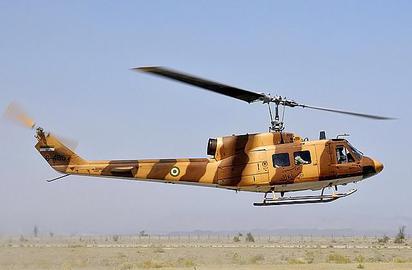
The Aviation Unit of the IRGC Forces was formed in 2015, by order of the Commander in Chief of the Armed Forces, Supreme Leader Ayatollah Ali Khamenei. It is stationed in the Fath Headquarters in Karaj, Albor Province. The commander of the unit is appointed by IRGC’s chief commander. This unit focusses on “helicopter support” and “offensive operations”. It has three major subunits: Advanced Aviation Training Center, Helicopter Research Center, and Helicopter Professional Repair Center.
Additional subunit, the Seyyed-al-Shohada Aviation Base was established in July 2017 in Shiraz. Its area of operation is within the provinces of Fars, Hurmozgan, Khuzestan, Sistan and Baluchestan, Kerman, Bushehr, and Kohgiluye and Boyer-Ahmad. Over the years, the Aviation unit has grown in size and influence, operating all IRGC helicopters and handling critical aerial missions.
The Drone Center (Markaz-e Pahpadi)
The Drone Center of the IRGC Ground Forces was established in 2016. The reasons for the establishment of the center are stated as: “the efficient use of drones in operations, heliborne operations, enemy reconnaissance, and assault operations.”
The Self-Sufficiency Jihad Research Organization (Sazman-e Tahghighat va Jahad-e Khod Kafaee)
The Self-Sufficiency Jihad Research Organization of the IRGC Ground Forces is a military research institution that develops and manufactures armaments. It was established in 1993 and has always been associated with the IRGC’s Imam Hussein University in terms of research and design. Its products include weapons, missiles, armored vehicles, radio communication equipment as well as equipment to be used in cyber warfare.
Hazrat Amir-al-Momenin University (Mojtamae Daneshgahi-e Hazrat Amir-al-Momenin)
Hazrat Amir-al-Momenin University is based in Isfahan. Its mission statement includes: “organizing the required training for the IRGC Ground Forces,” and “training loyal and ready-to-fight warriors.” During the Iran-Iraq War, the university played an important role in ideological indoctrination and military training of the Basij volunteers and the IRGC cadres. According to its commander, General Mohammad Karami, more than 70 percent of war martyrs from Esfahan and Chaharmahal Bakhtiari Provinces were trainees of the university. The courses at the university include general studies, artillery, defensive strategies, telecommunications and special forces training. In addition to military studies, the university offers ideological, educational and political teachings.
The Poverty Alleviation Headquarters (Ghrargah-e Mahroomiat Zodaee)
The IRGC has established multiple poverty alleviating headquarters to lead development projects in various regions. These activities have turned these headquarters into powerful economic institutions in Iran.
These headquarters, such as Shahid Mir-Husseini in Sistan and Baluchestan and Samen-al-Aeme II in Southern Khorasan, execute projects in infrastructure, agriculture, and community welfare. Their activities include distributing food, providing loans, and building essential facilities like small workshops.
The Military Medical Center (Markaz-e Behdari-e Razmi)
The Military Medical Center is part of IRGC’s Medical Division. The center specializes in installing portable hospitals, providing medical care the IRGC Ground Forces units, sending medical teams on camps, road-trips, and military exercises. The center, in collaboration with the Ministry of Health and Medical Education engaged in public healthcare projects, turning the center into a profit-making business for the IRGC. The center also supports the Poverty Alleviation Headquarters of the IRGC Ground Forces with its medical needs.
The center owns and operates numerous field, mobile, and permanent hospitals across Iran, and their number has been steadily increasing. For example, in May 2003, the center announced that over the previous decade, it had established 58 field hospitals in the southeastern province of Sistan and Baluchistan. The center’s regional commander stated that these 58 hospitals had provided medical services to nearly 2.5 million people and had performed 230,000 surgeries.
The Military Engineering and Logistics Center (Mohandesi-e Razmi va Poshtibani)
This center operates under the War Division (Moavenat-e Razmi) of the IRGC Ground Forces and plays a vital role in military and security operations, relying on dozens of its own engineering brigades. One of the center's most important missions is to secure the country’s borders by erecting obstacles and setting up temporary bases and defensive fortifications to prevent infiltration by saboteurs and terrorists.
The center is also responsible for providing engineering services during military operations, such as constructing pontoon bridges, access roads, and trenches, maintaining fortifications, and removing natural and artificial obstacles that hinder friendly forces.
The center has numerous engineering groups, brigades, and divisions stationed in various locations across the country. For example, Qadr Engineering Division 42 is one of these units, headquartered near the city of Arak in Markazi province.
In addition to its military and security services, the center participates in civilian development projects, such as building roads, airports, hospitals, sports and cultural centers, and water supply infrastructure. The center is equipped with advanced engineering tools, including heavy road construction machinery, mobile bridges, excavation equipment, and more, giving it the capability to execute complex engineering projects under diverse conditions.
Service Organizations (Nahadhay-e Khadamati)
These cooperatives and commercial entities are primarily engaged in housing projects, both for members of the IRGC Ground Forces and the general public. One of the largest projects undertaken by these cooperatives, including the IRGC Ground Forces Housing Cooperatives, is the Shaid Hossein Kharrazi Project, named after a commander who was killed during the Iran-Iraq War. The project to build this residential complex in District 22 of Tehran began several years ago and has been expanding ever since. To date, it has provided 8,030 housing units to members of the IRGC Ground Forces and the public.
Another important service organization is the Employees’ Welfare Services (Markaz-e Khadamat-e Refahi-e Karkonan), which supplies food, groceries, and day-to-day items to IRGC members.
IRGC Ground Forces has also created many other organizations in the fields of health, education and culture that offer various services to its members. These entities include hospitals and education, sports and cultural centers.
The Commander in Chief of the Armed Forces
The Chief Commander of the IRGC
The Supreme Leader’s Representative in the IRGC
The IRGC Security and Intelligence Agencies
The IRGC's Social, Cultural, Scientific and Educational Institutions
The IRGC Commercial and Financial Institutions-(Khatam-al-Anbiya Construction Headquarters)
The IRGC Commercial and Financial Institutions-(Bonyad-e Ta’avon-e Sepah)
The Organization for the Mobilization of the Oppressed
The Basij Cooperative Foundation
Cyberspace Institutions and The Physical Training Organization of the Basij
Basij Headquarters and Military Organizations
Basij Social and Cultural Organizations

Interested in writing for IranWire?
Share your stories.


comments