



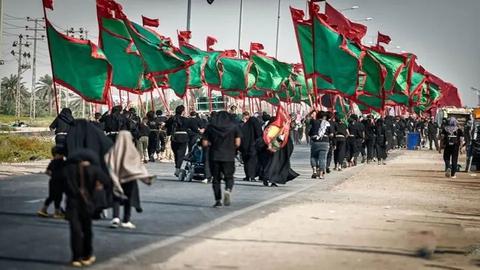
As millions of Shia pilgrims stream toward Iraq for the annual Arbaeen observance, Iran's government is using the massive religious gathering to advance sectarian goals in the country's predominantly Sunni Kurdish regions.
The Islamic Republic has provided extensive facilities for travelers bound for Iraq at border crossings, including the Bashmaq crossing near Marivan in Kurdistan Province.
Several national and provincial officials have visited the crossing in recent days as part of what authorities frame as supporting religious observance.
However, in areas where the Sunni majority does not share beliefs associated with Arbaeen, which commemorates the 40th day after the death of Imam Hussein, the third Shia imam, residents and religious leaders view the government's efforts as sectarian promotion rather than genuine religious accommodation.
"We have no belief in this matter," said a shopkeeper in Marivan. "Our welcome for this issue is only because the city becomes busy for a few days, and the market comes to life."
Like many others, the merchant welcomes the economic activity generated by tens of thousands of pilgrims, despite philosophical objections to what they see as government-sponsored Shia evangelism.
Even so, the short-term economic benefits have failed to translate into lasting development.
The few-kilometer route between Marivan and the Bashmaq border remains in poor condition despite the massive annual traffic.
Officials have said since 2019 that the border serves as a development axis for Kurdistan, but the official plan has achieved only 17 percent physical progress.
Iranian authorities, supported by Friday prayer leaders and other platforms, portray the facilitation of the pilgrimage as a way to promote Shia-Sunni unity.
Fayeq Rostami, Friday prayer leader of Sanandaj and a representative in the Assembly of Experts, said last year: "The Arbaeen movement and pilgrims' transit through Kurdistan and Marivan's Bashmaq border, apart from bringing economic blessings to the province, strengthen unity between Islamic sects."
This year, the government has established new ceremonies called "Those Left Behind from Arbaeen" in Sunni-populated cities of Kurdistan - events that do not align with local religious beliefs and that many Sunnis see as attempts to promote Shia practices.
Local Sunni religious leaders reject the unity narrative, pointing to systemic discrimination that they say reveals the government's true sectarian agenda.
"Unity becomes meaningful when I, as a Sunni, can perform the most basic Islamic ceremony, Friday prayer, in a mosque dedicated to Sunnis in a city where hundreds of thousands of Sunnis are present," said one Sunni leader, referring to Tehran's lack of designated Sunni mosques.
The religious leader also highlighted disparities in treatment between the two communities: "How is it that in all cities with Sunni majorities, where only a few hundred Shia live, Husseiniyehs [Shia religious centers] have been established, but such facilities are not available for Sunnis in Tehran?"
The government's sectarian approach extends beyond religious facilities to historical preservation.
In Saqqez, another Kurdish city, the Islamic Republic demolished the historic Narin Castle shortly after the 1979 revolution.
After completely erasing the structure and its historical traces, authorities built a Husseiniyeh in its place.

Interested in writing for IranWire?
Share your stories.


comments