



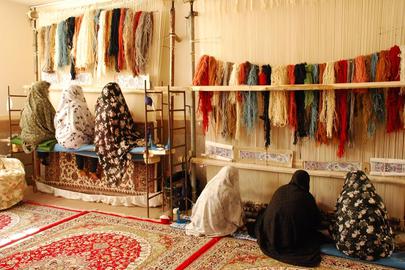
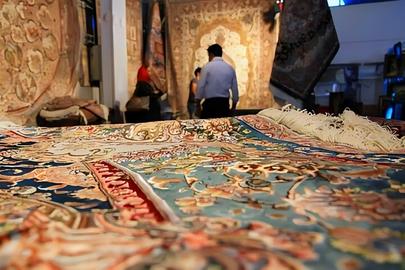
Handwoven carpets may be considered Iran’s most important non-oil export and a significant contributor to the country’s budget. Before the sanctions, revenue from Iranian handwoven carpet exports reached approximately $300 million.
However, after extensive sanctions were imposed, mostly due to the Islamic Republic’s nuclear ambitions, its share in international markets has declined.
The struggling state of the carpet and handicraft industry in Iran directly or indirectly affects the lives of at least 10 million people, particularly female carpet weavers.
According to official government statistics, more than two million people in Iran are engaged in weaving, most of whom are women and girls. Despite the hardships and criticisms surrounding the exploitation of workers by employers, the carpet weaving industry remains one of Iran’s key non-oil employment markets. However, workshops across various provinces are now closing due to the decline of the market.
A female carpet weaver from Kashan, whose workshop is on the verge of shutting down after years of work, told IranWire, “Since 2019, things have gotten worse each year. My six sisters and I have been weaving carpets since we were eight. Every three months, we would complete one carpet, and weaving is the only way we make a living. All of us have weakened eyesight. After marriage, each of us went on with our lives, but we continued weaving. I raised my two children on the income from carpet weaving, but since 2019, things have gotten worse and worse.”
The woman, whose husband was a day laborer and became disabled after falling from scaffolding in 2019, adds, “Now, my husband can no longer work, but even before, his work was inconsistent. I was the primary breadwinner. Now the workshop where I work is closing because carpets aren’t selling, and the owner says he’s going to revoke his license and open a grocery store or a sewing workshop instead.”
Describing her working conditions and those of the other female weavers in her workshop, she says: “All the workers are women. We start work every day at 8 a.m. and tie knots until 1 p.m. After a short lunch break, we continue working until at least 7 p.m. Wages are very low. A fine six-meter silk carpet might sell for 100 million tomans ($1,560), but our wages, depending on skill, range from 3,000 to 10,000 tomans [each US dollar is over 64,000 tomans] per hour.”
Despite these meagre earnings, losing this income would be a major challenge for these women, many of whom are the heads of their households.
Carpet weaving is widespread in cities and provinces across Iran, with some cities like Tabriz, Isfahan, and Kashan being particularly well-known. However, carpet workshops in other provinces are now facing closure.
A woman from Qaleh Ganj in Kerman, who weaves carpets, says their products haven’t sold for a long time, “In our village, every woman has a loom, large or small, and one or more people in each household weave carpets. Some of us didn’t even have the initial funds to set up the loom, and the Imam Khomeini Relief Committee or the Mostazafan Foundation provided the basic materials and purchased our products. But now they no longer buy from us, and the carpets are piling up.”
The wages these weavers receive are extremely low, “It takes about six months to weave a small carpet. The money my sister and I earn is barely enough to live on, but after our father passed away, we have no choice but to continue working. I also do Baluchi embroidery, but it doesn’t sell like it used to.”
Why is Iran’s Carpet Industry Falling?
According to various statistics, more than 65 per cent of the country’s carpet weavers live in rural areas. In Kurdistan, 95 per cent of the weavers are rural women.
The 1990s were a golden era for Iranian carpet exports, bringing in more than $2 billion to Iran. However, in 2023, carpet exports earned only $40 million.
There are no exact figures on carpet production, but the Iranian Handwoven Carpet Producers and Exporters Association website quotes its Vice President, Hamed Chamanrokh, saying, “Overall, we estimate a 70 per cent decline in production, while the National Carpet Center claims a 30 per cent increase, which I don’t understand - where is this growth coming from when production is down across the board?”
Chamanrokh attributes the decline of the carpet industry primarily to export restrictions due to sanctions. Other factors include the COVID-19 pandemic and Iran’s ongoing economic crisis. He says that handwoven carpets are now considered a non-essential item for many people in Iran.
Another contributing factor is rural depopulation, as villagers migrate to urban areas for unstable jobs, a trend that has accelerated in the past decade.
Meanwhile, Mohammad Reza Zareh Barzashi, the head of the National Center for Creative Industries and Carpets of Iran, says, “In 2022, three and a half million square meters of handwoven carpets were produced, and this figure has increased by 11 per cent to 3.9 million square meters in 2023.”
The Consequences of the Carpet Market’s Decline: Weavers Losing Jobs, Workshops Closing
A carpet workshop owner in Kashan told IranWire, “We are in serious trouble. I have a small workshop with 80 workers, but with the near collapse of carpet exports, we can’t rely on the domestic market anymore. Workshops are closing one by one. Not only do the workers lose their jobs, but many others - spinners, designers, knotters, exporters, and traders - are also affected. In Isfahan, more than 220,000 workshops exist, and many of the smaller ones are on the verge of closure.”
On September 15, Mojtaba Taj, head of the Isfahan Handicrafts Union, told ISNA news agency, “More than 400 license holders in the handicrafts sector have come to me to cancel their licenses and switch to other jobs.”
He said most of them are looking to drive for Snapp - the Iranian version of Uber - or open businesses related to food and clothing.
Reports indicate that in West Azerbaijan province, 72,000 people work in 1,500 small and large carpet workshops. In Kurdistan province, 50,000 handwoven carpet weavers are active, while 170,000 weavers are employed in Fars province. In rural areas of Golestan province and among the nomads of Kohgiluyeh and Boyer-Ahmad province, carpet weaving is also a major part of the local economy.
The Struggles of Carpet Weavers: ‘We’re Getting Blind, and We Don’t Have Insurance’
The female weaver who spoke with IranWire says, “As I mentioned, all of our eyesight has deteriorated, and one of my sisters has had back problems so severe that she gave up weaving three years ago.
“I’ve had anthrax a few times because the wool we use carries it. The poor lighting and lack of proper ventilation in the workshops have caused respiratory and vision problems for many of my colleagues, and a lot of them also have problems with seeing and breathing.
“But almost none of us have insurance. We’ve protested several times, but due to economic hardship, we keep going back to the loom, and the issue of insurance has never been seriously addressed. Workshop owners, especially small ones, refuse to take responsibility for such things. Most workshops are run by intermediaries, and we never even meet the real owners.”
The Iran National Carpet Center reports that out of the two million carpet weavers, only 230,000 have social security insurance. Another 50,000 are covered by rural and nomadic insurance, meaning only about 14 per cent of the total carpet-weaving population has any insurance.
The Crisis in Iran’s Handicraft Industry
Most people working in the handicraft sector are women who head households and are deprived of insurance benefits. These women weave carpets and mats, and they do pottery, embroidery, and needlework. Yet, their hard-earned products are sold for meagre amounts to middlemen.
In recent years, the rise of eco-tourism homes provided small markets for handicraft artisans to sell their products directly in small towns and villages. However, the decline in tourism, especially international visitors, has closed this small window of opportunity.
Some handicraft artists have attempted to sell their products via social media platforms and online marketplaces, but increased censorship and restrictions on online businesses have blocked this path as well.
Abbas Shirdeli, the former head of the Handicrafts Union of Isfahan, told ISNA, “In 2017, the Parliament’s Research Center approved a law to support artists, masters, and craftsmen, and it was communicated to the government. However, unfortunately, this law has not been pursued by the Ministry of Cultural Heritage and the Handicrafts Directorates under the previous two administrations, despite the fact that all the needs of artists were addressed in its 15 articles.”
One of the promises made by Masoud Pezeshkian during his presidential campaign was to revive the tourism industry and lift sanctions, but these promises seem to be increasingly forgotten.

Interested in writing for IranWire?
Share your stories.



comments